Table of Contents
ToggleWhat Is the Fastest Way to Learn to Draw?
What is the fastest way to learn to draw? It is one of the most common questions asked by people who have always wanted to become better at art but never knew where to begin. Perhaps you have watched an artist create a beautiful sketch in only a few minutes and wondered how they developed that ability. Maybe you bought a sketchbook, sharpened a pencil, drew a few lines, and quickly became frustrated because your drawing did not look anything like the reference. Or perhaps you have spent hours watching drawing tutorials online but still feel unsure about what you should practice next.
The good news is that learning to draw does not require you to be born with extraordinary artistic talent. Drawing is a trainable visual skill. The fastest learners are usually not people who magically possess perfect artistic ability. They are people who learn the right fundamentals in the right order, practice consistently, observe carefully, and receive clear instruction.
In 2026, beginners have more opportunities than ever to learn drawing from home. Online art education makes it possible to study sketching, drawing fundamentals, oil painting, composition, and other creative skills without having to travel to a traditional classroom. However, having access to thousands of tutorials can create another problem: information overload.
A beginner might watch a portrait tutorial in the morning, a perspective lesson in the afternoon, and a digital illustration video at night. Although each lesson may be useful individually, this approach does not necessarily create a strong foundation.
The fastest way to learn to draw is therefore not to consume as much information as possible. It is to create a simple, structured learning path that combines instruction with deliberate practice.
This is where an online art education platform such as WATOBE Online Art Lab can be particularly useful. WATOBE offers beginner-friendly online art courses, including a beginner sketching course that focuses on pencil techniques, line control, light and shadow, observation, composition, and proportion. Its courses are designed around clear learning objectives and practical exercises, while allowing students to learn from home and at their own pace.
What Is the Fastest Way to Learn to Draw?
The fastest practical approach is:
Learn fundamental skills → practice them consistently → draw from observation → study your mistakes → gradually increase difficulty.
For most beginners, the most important skills are:
- Line control
- Basic shapes and forms
- Observation
- Proportion
- Perspective
- Light and shadow
- Composition
- Regular sketching
Instead of trying to master everything at once, focus on one skill at a time and combine them gradually.
A useful beginner routine is 20–40 minutes of focused drawing practice several days per week.
The exact amount of time required varies from person to person. There is no scientifically guaranteed number of days in which everyone will “learn to draw.” However, consistent practice can produce noticeable improvement much sooner than irregular practice.
WATOBE’s own published guidance similarly emphasizes that beginners can see improvement within months with consistent practice and structured instruction rather than relying on talent alone.
Why Beginners Often Learn Slowly
Before discussing how to learn faster, it is important to understand why many beginners struggle.
1. They Practice Randomly
Random practice is one of the biggest obstacles.
A beginner may spend Monday drawing eyes, Tuesday drawing anime characters, Wednesday painting landscapes, and Thursday practicing perspective.
The problem is not that these activities are bad.
The problem is that the student may not understand how they connect.
A structured sequence creates stronger results.
2. They Start With Advanced Subjects
Many beginners immediately want to draw:
- Realistic portraits
- Hands
- Animals
- Cars
- Complex architecture
- Detailed characters
These subjects can be motivating, but they depend on fundamental skills.
If your proportions, construction, perspective, and values are weak, advanced subjects become unnecessarily difficult.
3. They Watch Instead of Practice
Watching an artist draw can feel productive.
But watching is not the same as drawing.
A useful rule is:
For every lesson you watch, spend time applying what you learned.
The pencil needs practice—not just the eyes.
4. They Expect Perfect Results
A beginner’s first sketches will probably contain mistakes.
That is normal.
The purpose of practice is not to create a portfolio-quality drawing every time.
The purpose is to identify what needs improvement.
What Beginners Truly Need to Learn First
If you are starting from zero, you do not need to learn everything.
Focus on the fundamentals.
Line Control
Practice drawing:
- Straight lines
- Curved lines
- Diagonal lines
- Circles
- Ellipses
- Long continuous strokes
The objective is to make your marks intentional.
Basic Shapes
Learn to recognize objects as combinations of:
- Spheres
- Cubes
- Cylinders
- Cones
For example, a cup can be simplified into a cylinder.
A head can be approached as a rounded three-dimensional form.
A building can be broken into boxes.
This way of thinking makes complex subjects much easier.
Observation
Good drawing begins with good observation.
Instead of asking:
“What am I drawing?”
ask:
“What shapes, angles, proportions, and values do I actually see?”
This small change in thinking can dramatically improve accuracy.
Proportion
Proportion refers to the size relationship between different parts of an object or composition.
For example:
- How wide is the cup compared with its height?
- How large is the head compared with the body?
- How far apart are two objects?
- How much of the page does the subject occupy?
Learning to compare proportions is essential for realistic drawing.
Perspective
Perspective allows artists to represent three-dimensional space on a two-dimensional surface.
Beginners can start with:
One-Point Perspective
Useful for:
- Roads
- Hallways
- Rooms
Two-Point Perspective
Useful for:
- Buildings
- Furniture
- Boxes
You do not need advanced perspective theory on your first day. Start with simple exercises and build gradually.
Light and Shadow
Shading creates the illusion of three-dimensional form.
Start with basic objects such as:
- Sphere
- Cube
- Cylinder
Identify:
- Light source
- Highlight
- Midtone
- Core shadow
- Reflected light
- Cast shadow
This foundation will later help with portrait drawing, still life, landscape painting, and oil painting.
The Fastest Beginner Drawing Method: Learn, Copy, Observe, Create
One effective way to organize practice is the Learn → Copy → Observe → Create cycle.
Stage 1: Learn
Study one specific concept.
For example:
How to draw a cylinder.
Understand:
- Its basic structure
- Ellipse shapes
- Perspective
- Light
Stage 2: Copy
Follow a guided demonstration.
Do not worry about producing an original masterpiece.
Your objective is to understand the process.
Stage 3: Observe
Now find a real cylinder.
Draw it without following the demonstration.
This tests whether you actually understood the concept.
Stage 4: Create
Use the skill in a new drawing.
For example, draw:
- A cup
- A bottle
- A vase
Now the skill becomes transferable.
This final stage is extremely important because real artistic ability comes from applying knowledge to unfamiliar subjects.
A 30-Minute Daily Drawing Routine
You do not necessarily need hours every day.
A focused 30-minute session can be divided into four parts.
5 Minutes: Warm-Up
Draw:
- Lines
- Circles
- Curves
- Ellipses
10 Minutes: Fundamentals
Practice one concept:
- Forms
- Perspective
- Proportion
- Shading
10 Minutes: Observation
Choose an everyday object and draw it.
5 Minutes: Review
Ask:
- What worked?
- What looks incorrect?
- What should I practice tomorrow?
This final review turns ordinary practice into deliberate practice.
The 7-Day Beginner Drawing Plan
Day 1 — Lines and Circles
Practice controlling your pencil.
Focus on smooth, confident marks.
Day 2 — Basic Forms
Draw:
- Cubes
- Spheres
- Cylinders
Day 3 — Observation
Choose three everyday objects.
Draw them from life.
Day 4 — Light and Shadow
Shade basic forms using one light source.
Day 5 — Perspective
Practice one-point perspective with simple boxes.
Day 6 — Composition
Arrange three objects and create a small still-life sketch.
Day 7 — Review
Repeat one drawing from Day 1.
Compare the results.
Do not judge yourself by whether the drawing is “beautiful.”
Look for measurable changes in:
- Line confidence
- Proportion
- Observation
- Shading

How Fast Can You Actually Learn to Draw?
There is no universal timeline.
Someone practicing 30 minutes five days a week will have a very different experience from someone drawing once every two weeks.
Your progress depends on:
- Practice frequency
- Practice quality
- Previous experience
- Instruction quality
- Subject difficulty
- Ability to identify mistakes
A reasonable goal is not:
“I will become an expert in 30 days.”
A better goal is:
“I will become noticeably better every month.”
WATOBE’s published material describes a similar principle: consistent practice combined with structured learning can help beginners develop basic drawing skills over a period of months.
What Art Supplies Do You Actually Need?
You do not need an expensive studio.
For Beginners
A basic setup can include:
- HB pencil
- 2B pencil
- 4B pencil
- Sketchbook
- Eraser
- Sharpener
That’s enough to begin learning fundamental drawing.
Is It Faster to Learn With an Online Drawing Course?
For many beginners, structured online instruction can make learning more efficient because it reduces the amount of time spent deciding what to practice next.
A good online course should provide:
- Clear lessons
- Progressive difficulty
- Demonstrations
- Practical exercises
- Beginner-friendly explanations
- Flexible access
WATOBE’s course structure includes guided online lessons and practical exercises, while its beginner sketching course specifically covers pencil techniques, line control, shading, observation, composition, and proportion
Why WATOBE Online Art Lab Is Worth Exploring
If you’re asking “What is the fastest way to learn to draw?”, the answer is not simply “find more tutorials.”
It is to find a learning system that helps you practice the right skills consistently.
WATOBE Online Art Lab is designed around this principle.
According to its course information, WATOBE has more than a decade of hands-on teaching experience and creates courses with clear learning objectives covering both essential skills and artistic knowledge.
Its online format is designed around learning anywhere and anytime, which can make consistent practice easier for students with different schedules.
What Can You Learn With WATOBE?
Beginner Sketching
The beginner sketching course covers:
- Basic pencil techniques
- Line control
- Shading
- Tonal values
- Observation
- Composition
- Proportion
- Developing a personal sketching style
This makes it particularly relevant to people who are starting from the fundamentals.
Free and Low-Cost Ways to Start
If budget is a concern, you do not have to wait until you can purchase a complete art studio.
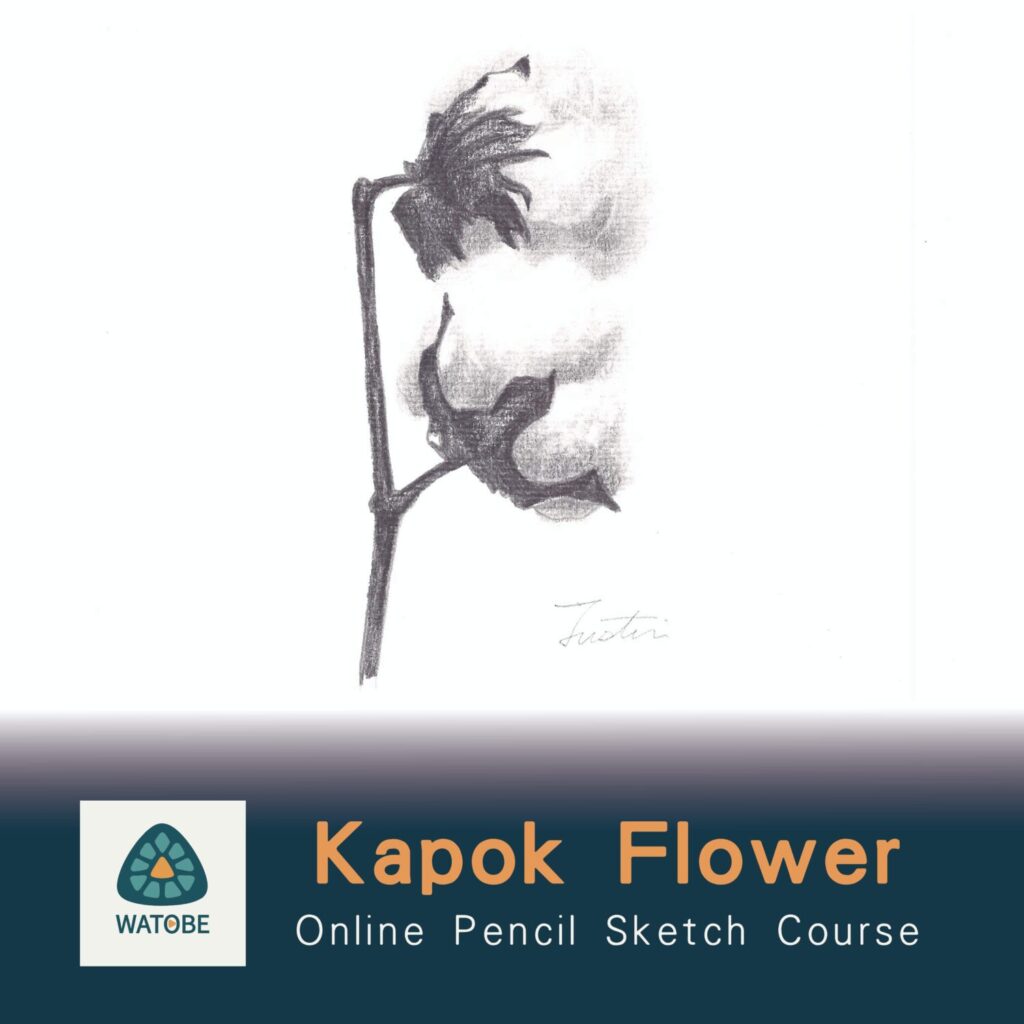
WATOBE’s website currently features a Beginner Drawing Course – Kapok Flower with video and templates listed at $0, alongside other beginner drawing projects.
This creates a practical entry point for someone who wants to experience guided drawing before committing to a broader learning path.
Free resources can be especially useful during the exploration stage.
However, remember:
Free does not automatically mean structured.
The important question is not only whether a lesson costs money.
Ask:
“Does this lesson teach me what I should practice next?”
The Biggest Secret to Learning Faster: Don't Skip Fundamentals
Suppose you want to draw portraits.
You might think you should immediately study eyes, noses, mouths, and hair.
But realistic portraits depend on:
- Proportion
- Perspective
- Head construction
- Light
- Shadow
- Anatomy
The same principle applies to other subjects.
Want to draw animals?
Learn basic forms and gesture.
Want to draw buildings?
Learn perspective.
Want to paint landscapes?
Learn composition, values, and observation.
Want to paint with oils?
Learn drawing, proportion, values, and color.
Fundamentals are not a detour.
They are the shortcut.
Common Mistakes That Prevent Fast Improvement
Mistake #1: Changing Courses Every Week
Choose one learning path and give yourself enough time to complete it.
Mistake #2: Drawing Only What You Like
It is fine to draw subjects you enjoy.
But occasionally practice subjects that challenge your weaknesses.
Mistake #3: Avoiding Difficult Exercises
If perspective is difficult, don’t avoid it.
Practice it.
The skill you dislike practicing may be exactly the skill you need most.
Mistake #4: Erasing Everything
Do not erase every mistake immediately.
Sometimes studying your mistakes teaches more than hiding them.
Mistake #5: Comparing Yourself With Professionals
A professional artist’s finished illustration may represent years of experience.
Compare your current work with your own earlier work instead.

How to Learn Drawing Faster Without Burning Out
Speed should not mean pressure.
If you practice too aggressively, you may lose motivation.
Instead:
Keep sessions short.
20–40 minutes can be enough for a focused session.
Take breaks.
Rest helps maintain concentration.
Alternate exercises and fun projects.
Don’t make every session technical.
Celebrate small wins.
A better circle is progress.
A more accurate proportion is progress.
A more confident line is progress.
Frequently Asked Questions
What is the fastest way to learn to draw?
The fastest practical approach is to learn fundamental drawing skills in a structured sequence and practice them consistently. Start with line control, shapes, observation, proportion, perspective, and light and shadow. Then gradually apply those skills to increasingly complex subjects.
Can I learn to draw if I have no talent?
Yes. Drawing can be learned as a skill. Natural ability may influence how quickly different people progress, but observation, practice, instruction, and consistency are far more useful than simply assuming you need artistic talent.
Can I learn to draw online?
Yes. Online drawing courses can provide demonstrations, structured lessons, exercises, and flexible practice. WATOBE Online Art Lab offers beginner-focused online drawing and art courses that allow learners to study from home and progress at their own pace.
How long should I practice drawing each day?
There is no universal requirement. For beginners, a focused 20–40 minute session can be a practical starting point. Consistency is generally more important than forcing yourself to practice for several hours.
What should I draw first?
Start with simple subjects:
- Lines
- Circles
- Cubes
- Spheres
- Cylinders
- Everyday objects
Then gradually progress toward people, landscapes, animals, and more complex compositions.
Should I learn drawing before oil painting?
Learning drawing fundamentals first can be very helpful because drawing develops observation, proportion, structure, and value skills that are useful when painting. However, beginners can also explore painting while developing drawing skills.
WATOBE offers both beginner sketching and beginner oil painting courses, allowing students to explore both areas.
What is the best pencil for a beginner?
An HB pencil is an excellent starting point. You can later add softer grades such as 2B, 4B, and 6B for darker values and shading.
Is drawing difficult to learn?
Drawing can feel difficult at first because your eyes may see more accurately than your hand can reproduce. With practice, the connection between observation and hand movement improves.
Are online art courses suitable for children?
Yes, provided the course is age-appropriate and encourages creativity rather than excessive pressure. WATOBE offers a Kids Art Exploration Course centered on colors, shapes, stories, and guided creative activities.
The Fastest Way Is the Right Way
So, what is the fastest way to learn to draw?
It is not buying the most expensive pencils.
It is not watching hundreds of YouTube videos.
It is not trying to copy professional artwork immediately.
And it is certainly not waiting until you believe you have enough talent.
The fastest practical approach is to learn the fundamentals in a logical order, practice consistently, draw from observation, understand your mistakes, and gradually increase the difficulty of your exercises.
Start with lines.
Move to shapes.
Learn form.
Study proportion.
Understand perspective.
Practice light and shadow.
Then combine those skills into complete drawings.
If you want structured guidance, WATOBE Online Art Lab provides beginner-oriented online art education with drawing, sketching, oil painting, and children’s art options. Its beginner sketching curriculum specifically focuses on foundational skills such as pencil techniques, line control, shading, observation, composition, and proportion.
The platform also emphasizes flexible learning from anywhere and offers both digital-only learning and complete materials-kit options, making it possible for different types of learners to choose a setup that fits their needs.
Most importantly, remember this:
You don’t need to become an artist before you start drawing.
You become an artist by starting.
Pick up a pencil today.
Draw one line.
Then another.
And keep going.
Your first drawing does not need to be impressive.
It simply needs to be your first step.